
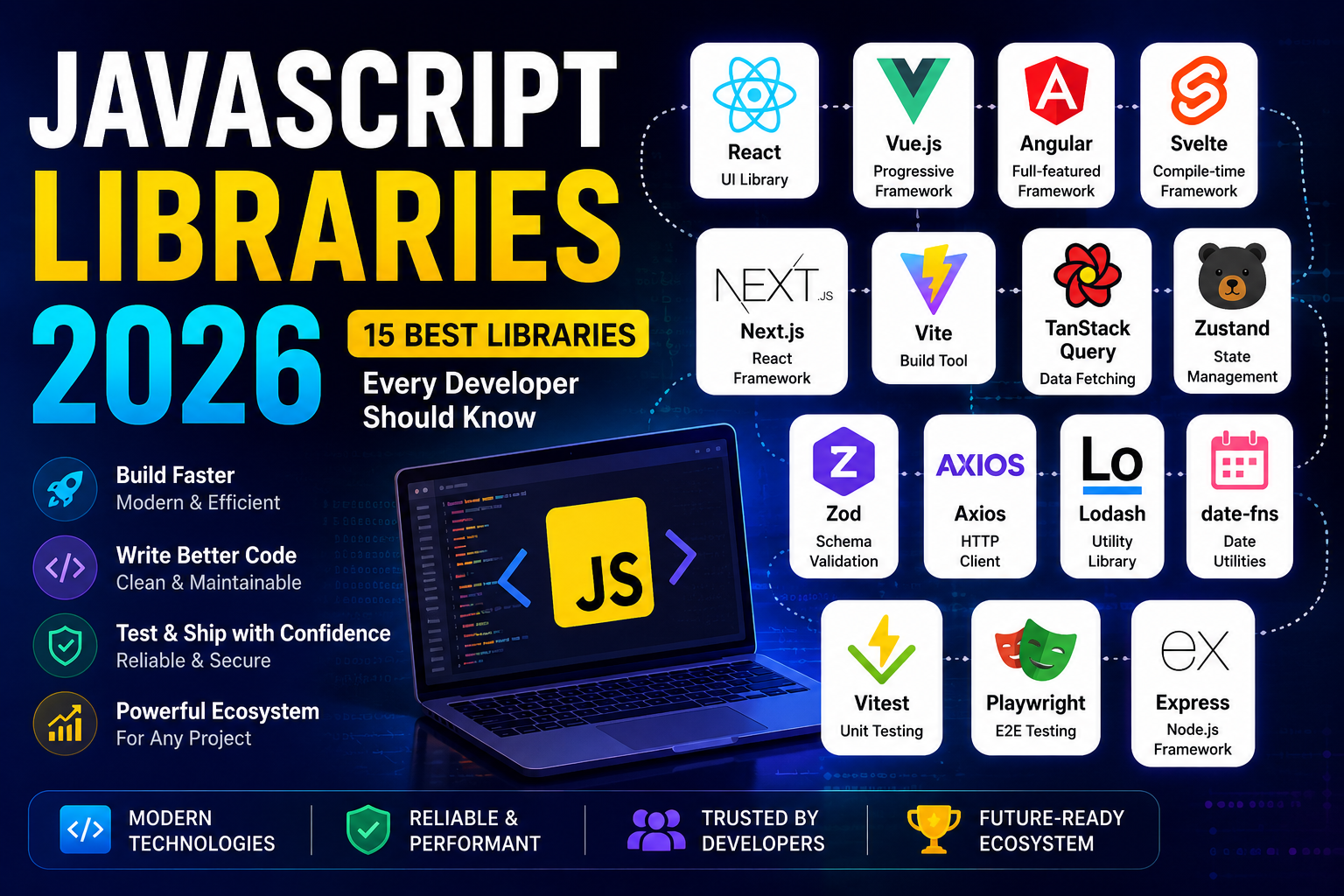
JavaScript libraries 2026 mein pehle se kaafi zyada diverse ho gayi hain. Developers ke paas UI development, API requests, state management, validation, testing, animation, dates, charts aur build tooling ke liye dozens of mature options available hain.
Lekin problem ye hai ki har JavaScript library har project ke liye useful nahi hoti.
React ek excellent choice ho sakta hai for large frontend applications, while Zod may be more useful when you need runtime validation. TanStack Query is designed for server-state and data fetching, while Vitest focuses on testing. Vite, meanwhile, is a build tool rather than a traditional application library.
So instead of simply listing popular packages, this guide explains the best JavaScript libraries in 2026, what they are used for, their strengths and limitations, and which ones developers should learn first.
Quick Answer: What Are the Best JavaScript Libraries in 2026?
Here are some of the most useful JavaScript libraries and tools to know in 2026:
| Library / Tool | Best For | Category |
|---|---|---|
| React | User interfaces | Frontend |
| Vue.js | Progressive web apps | Frontend |
| Angular | Enterprise applications | Frontend framework |
| Svelte | Lightweight interfaces | Frontend |
| Next.js | Full-stack React applications | Meta-framework |
| Vite | Fast development/build tooling | Build tool |
| TanStack Query | API data & server state | Data fetching |
| Zustand | Client state management | State management |
| Zod | Runtime validation | Validation |
| Axios | HTTP/API requests | Networking |
| Lodash | Utility functions | Utilities |
| date-fns | Date manipulation | Date/time |
| Vitest | Unit testing | Testing |
| Playwright | Browser/end-to-end testing | Testing |
| Express | Node.js APIs | Backend |
The right choice depends on the type of application you are building.
What Is a JavaScript Library?
A JavaScript library is reusable code that developers can add to their projects instead of implementing common functionality from scratch.
For example, instead of manually writing complex code for:
- API requests
- Date formatting
- Form validation
- State management
- UI components
- Testing
- Animations
you can use an established library.
This can reduce development time and make applications easier to maintain.
However, adding a dependency isn’t automatically better. Every package adds maintenance, upgrade and security considerations.
That is particularly important in the JavaScript ecosystem because applications can depend on large dependency trees. Recent research analyzing more than one million JavaScript packages found widespread dependency relationships and vulnerabilities across the npm ecosystem.
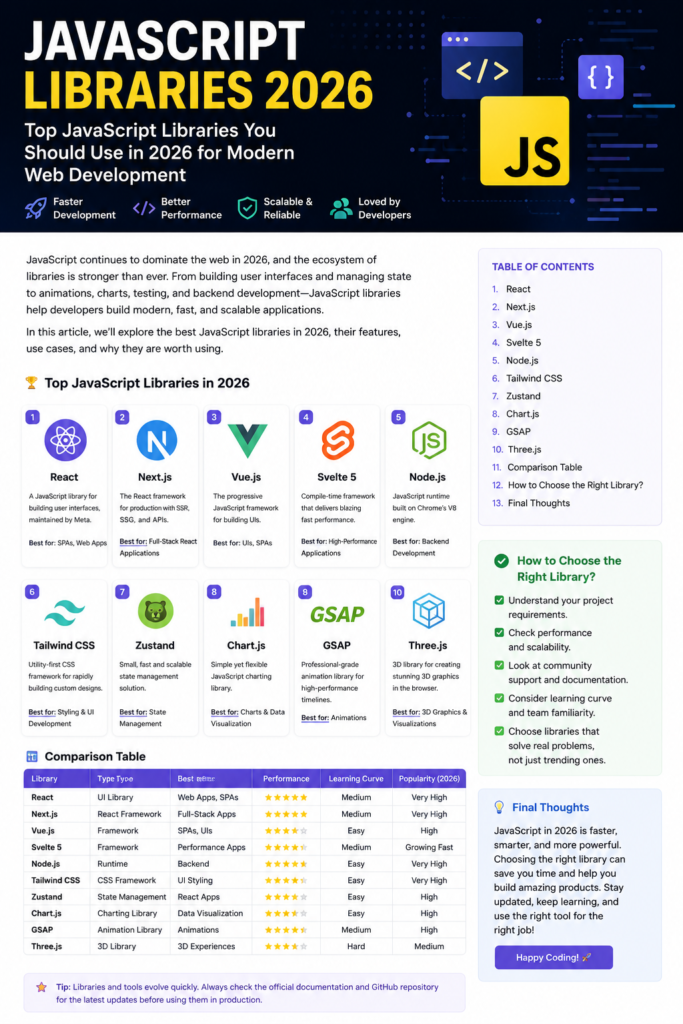
1. React
Best for: Modern frontend applications
React remains one of the most important technologies in the JavaScript ecosystem.
Technically, React describes itself as a library for building user interfaces, although many developers use it as the foundation of complete frontend applications.
React 19 is stable, and the official React version history shows the 19.2 release line continuing through 2026.
Why React is still important in 2026
React has several advantages:
- Huge ecosystem
- Component-based architecture
- Strong TypeScript support
- Large developer community
- Extensive third-party libraries
- React Native for mobile development
- Strong job-market relevance
State of JS 2025 placed React among the most-used technologies in its libraries/frameworks ecosystem.
Best use cases
React is particularly suitable for:
- SaaS applications
- Dashboards
- E-commerce websites
- Admin panels
- Complex web applications
- Interactive websites
Should you learn React in 2026?
Yes.
If your goal is frontend development or JavaScript employment, React remains one of the safest technologies to learn.
2. Vue.js
Best for: Flexible frontend development and progressive adoption
Vue.js is another major JavaScript frontend framework.
One of Vue’s biggest advantages is that it can be introduced gradually into projects.
It offers:
- Component architecture
- Reactive state
- Single-file components
- TypeScript support
- Strong tooling
- Large ecosystem
State of JS 2025 places Vue among the prominent frontend technologies and reports strong retention relative to usage.
Vue is especially good for
- Small-to-medium applications
- Dashboards
- Prototypes
- Existing websites that need interactivity
- Teams that prefer a structured but approachable framework
React vs Vue
Choose React if:
- You want the largest ecosystem
- You’re targeting React-heavy job markets
- You want React Native
- You prefer JSX
Choose Vue if:
- You want a gentler learning curve
- You prefer single-file components
- You want progressive adoption
3. Angular
Best for: Large enterprise applications
Angular is a full-featured framework maintained by Google.
Unlike React, Angular provides a more complete structure out of the box.
It includes concepts and tooling for:
- Routing
- Dependency injection
- Forms
- HTTP
- Components
- Testing
- TypeScript development
This makes Angular particularly attractive for large organizations that want a standardized application architecture.
Best use cases
Angular works well for:
- Enterprise applications
- Large internal tools
- Complex dashboards
- Financial applications
- Long-term business applications
Angular vs React
React generally gives developers more architectural freedom.
Angular gives you more structure.
So:
React = flexibility
Angular = opinionated structure
4. Svelte
Best for: Lightweight and highly reactive web interfaces
Svelte takes a different approach from traditional runtime-heavy frontend frameworks.
Instead of doing most of its work in the browser at runtime, Svelte compiles components during the build process.
This can help produce efficient applications.
State of JS 2025 shows Svelte continuing to have strong satisfaction among developers, while community discussions in 2026 continue to highlight its reactivity and lightweight approach.
Svelte is good for
- Interactive websites
- Smaller applications
- Performance-sensitive interfaces
- Developers who like a compiler-based approach
Is Svelte replacing React?
Not currently.
React still has a much larger ecosystem and usage footprint.
Svelte is better viewed as an important alternative rather than a replacement.
5. Next.js
Best for: Full-stack React applications
Next.js extends the React ecosystem with features needed for production applications.
It can handle:
- Routing
- Server rendering
- Static generation
- Server-side functionality
- API integration
- Full-stack application patterns
State of JS 2025 shows Next.js as one of the major meta-frameworks, although it also has a more polarized satisfaction profile than several alternatives.
Why developers use Next.js
It can simplify the process of building:
- SaaS products
- E-commerce websites
- Marketing websites
- Content platforms
- Full-stack applications
Important distinction
Next.js is technically a React framework/meta-framework, not simply a JavaScript utility library.
That’s why you shouldn’t compare it directly with something like Lodash.
6. Vite
Best for: Modern JavaScript development and build tooling
Vite has become one of the most important pieces of the modern JavaScript ecosystem.
It provides:
- Fast development server
- Hot Module Replacement
- Production builds
- Plugin ecosystem
- Support for multiple frameworks
The official Vite documentation describes it as a build tool designed for a faster and leaner development experience. Its production build system uses Rolldown.
State of JS 2025 reported that Vite had overtaken React in usage in the survey’s overall list and continued to rank extremely highly for developer sentiment.
Vite supports
- React
- Vue
- Svelte
- Preact
- Solid
- Lit
- Vanilla JavaScript
- TypeScript
Should developers learn Vite?
Absolutely.
If you’re starting modern frontend development, knowing how Vite works is increasingly useful.
7. TanStack Query
Best for: API data fetching and server-state management
TanStack Query is one of the most useful libraries for applications that communicate with APIs.
Instead of manually managing:
- Loading states
- Cache
- Refetching
- Retries
- Stale data
- Mutations
- Background updates
TanStack Query provides these capabilities through a declarative API.
The official documentation describes it as a tool for fetching, caching, updating and managing asynchronous/server state across React, Vue, Solid, Svelte and Angular applications.
Example
const { data, isPending, error } = useQuery({
  queryKey: ['users'],
  queryFn: fetchUsers
});
Why it matters
Modern applications frequently depend on APIs.
TanStack Query can dramatically reduce the amount of custom data-fetching and caching code developers have to maintain.
Best for
- SaaS
- E-commerce
- Dashboards
- Social apps
- Admin panels
- API-driven applications
8. Zod
Best for: Type-safe data validation
Zod has become particularly important in TypeScript applications.
It allows developers to define schemas and validate untrusted data at runtime.
For example:
import { z } from "zod";

const User = z.object({
  name: z.string(),
  age: z.number(),
});
You can then validate incoming data.
The official Zod documentation describes it as a TypeScript-first validation library with static type inference. Zod 4 is currently stable.
Why Zod is useful
TypeScript checks types during development.
But external data can still be incorrect.
For example, an API might return:
{
  "name": 123
}
even though your application expects:
name: stringZod allows you to validate that data at runtime.
Best use cases
- REST APIs
- Forms
- Environment variables
- Configuration
- User input
- Full-stack TypeScript applications
9. Zustand
Best for: Simple client-side state management
Zustand is a lightweight state-management solution commonly used in React applications.
It can be useful when application state becomes too complicated for basic React state but a large Redux architecture feels unnecessary.
Common use cases
- Shopping carts
- Authentication state
- UI preferences
- Filters
- Multi-step workflows
- Global application state
Zustand vs Redux
Zustand
- Smaller API
- Less boilerplate
- Quick to learn
Redux Toolkit
- Strong conventions
- Large ecosystem
- Excellent for complex state architectures
For a small or medium React application, Zustand can often be simpler.
10. Axios
Best for: HTTP requests
Axios remains a familiar HTTP client for JavaScript applications.
It provides features such as:
- GET/POST/PUT/DELETE requests
- Request interceptors
- Response interceptors
- Automatic JSON handling
- Request configuration
- Error handling
Example:
const response = await axios.get('/api/users');Axios vs Fetch
Modern browsers already provide the native fetch() API.
So you don’t always need Axios.
Use Fetch when:
- You want zero dependencies
- Your requirements are simple
Consider Axios when:
- You need interceptors
- You want a consistent HTTP abstraction
- Your application has complex API handling
11. Lodash
Best for: Utility functions
Lodash has been around for years, but it remains relevant because it provides a huge collection of utility functions.
Examples include:
- Array manipulation
- Object manipulation
- Deep comparison
- Debouncing
- Throttling
- String utilities
- Data transformations
The npm package currently has a large dependency footprint and tens of millions of weekly downloads, demonstrating that Lodash remains widely used.
Should you still use Lodash?
Sometimes.
Modern JavaScript has replaced many Lodash use cases with native methods.
For example:
array.map()
array.filter()
array.reduce()
Object.entries()
Object.values()
are now standard JavaScript.
So don’t automatically install Lodash for every project.
Use it when its utilities genuinely simplify your code.
12. date-fns
Best for: Date manipulation
Working with dates is one of the classic JavaScript development problems.
date-fns provides functions for:
- Formatting
- Parsing
- Comparing
- Adding/subtracting dates
- Date differences
- Time intervals
Instead of manually implementing date calculations, developers can use focused functions.
Alternatives
You may also encounter:
- Day.js
- Luxon
- Temporal APIs
The JavaScript ecosystem continues to evolve around date/time handling, so developers should understand the native platform capabilities before automatically adding another dependency.
13. Vitest
Best for: Modern JavaScript and TypeScript testing
Vitest is a modern testing framework built around Vite.
The official documentation describes it as a next-generation testing framework powered by Vite. It supports JavaScript, TypeScript and JSX and is designed to be compatible with many Jest-style APIs.
Why Vitest is becoming popular
It provides:
- Fast test execution
- Watch mode
- TypeScript support
- JSX support
- ESM support
- Vite integration
- Jest-compatible APIs
State of JS 2025 reported Vitest among the tools with one of the largest year-over-year usage increases in its dataset.
Vitest vs Jest
If you’re starting a new Vite-based project:
Vitest is worth considering first.
If you’re maintaining a large existing Jest codebase:
There may be no reason to migrate immediately.
14. Playwright
Best for: End-to-end browser testing
Playwright is designed for browser automation and end-to-end testing.
It can test applications across major browser engines.
Typical tests include:
- Login
- Checkout
- Navigation
- Forms
- Authentication
- API interactions
- User workflows
State of JS 2025 placed Playwright among the highest-satisfaction testing tools and reported a significant increase in usage.
Example use case
Imagine an e-commerce website.
Instead of manually checking:
Login → Search product → Add to cart → Checkout
Playwright can automate this entire workflow.
15. Express
Best for: Node.js backend APIs
Express is one of the most established JavaScript backend frameworks.
It is commonly used for:
- REST APIs
- Backend services
- Authentication
- Middleware
- Web servers
State of JS 2025 reported Express among the major back-end technologies and placed it strongly in its usage/satisfaction analysis.
Example
app.get('/api/users', (req, res) => {
  res.json(users);
});
Express is particularly useful for developers who want to build APIs using Node.js without adopting a heavily opinionated framework.
JavaScript Libraries vs JavaScript Frameworks
This distinction is important.
Many articles incorrectly call everything a “JavaScript library.”
Library
A library usually provides functionality that your application calls.
Examples:
- React
- Lodash
- Axios
- Zod
- TanStack Query
Framework
A framework generally provides more application structure and often controls more of the application’s lifecycle.
Examples:
- Angular
- Next.js
- Nuxt
- SvelteKit
Build Tool
A build tool handles development and production tooling.
Examples:
- Vite
- webpack
- esbuild
- Rolldown
So when someone searches for JavaScript libraries 2026, they may actually be looking for a broader JavaScript ecosystem overview.
That’s why this article includes all three categories but clearly labels them.
Best JavaScript Libraries 2026 by Use Case
Best for Frontend Development
React
Best overall ecosystem and job-market relevance.
Best React Alternative
Vue.js
Excellent balance between flexibility and simplicity.
Best Enterprise Framework
Angular
Strong structure for large applications.
Best Lightweight Framework
Svelte
Excellent for developers interested in compiler-based UI development.
Best React Full-Stack Framework
Next.js
Strong choice for full-stack React applications.
Best Build Tool
Vite
Fast development workflow and broad framework support.
Best API/Data Fetching Library
TanStack Query
Excellent for server-state, caching and asynchronous data.
Best Validation Library
Zod
Excellent for TypeScript-first runtime validation.
Best Lightweight State Manager
Zustand
Good choice for straightforward React state management.
Best Testing Framework
Vitest
Especially attractive for Vite-based projects.
Best End-to-End Testing Tool
Playwright
Excellent for browser automation and complete user-flow testing.
JavaScript Libraries Developers Should Learn in 2026
If you’re a beginner, don’t try to learn 15 libraries simultaneously.
A better learning path is:
Beginner
Learn:
- JavaScript fundamentals
- TypeScript
- React or Vue
- Git
- npm
- Vite
Intermediate
Then learn:
- TanStack Query
- Zod
- State management
- Testing with Vitest
- Playwright
Advanced
Then explore:
- Next.js
- Node.js
- Express
- Performance optimization
- Security
- Architecture
This gives you transferable knowledge instead of simply memorizing packages.
JavaScript Libraries 2026: What Is Changing?
The JavaScript ecosystem is moving toward several important trends.
1. Faster tooling
Tools such as Vite, Vitest and newer Rust-based tooling are reducing development and build times.
State of JS 2025 showed particularly strong momentum for Vite, Vitest and Playwright.
2. TypeScript-first development
More libraries are designed around TypeScript.
Zod is a strong example: its API is explicitly designed around TypeScript’s type system and runtime validation.
3. Server-state libraries are becoming more important
Modern applications consume APIs constantly.
Instead of putting every piece of API data into global client state, tools such as TanStack Query provide specialized server-state management with caching and synchronization.
4. Smaller and more focused dependencies
Developers are increasingly questioning whether they need large utility libraries for tasks that modern JavaScript can handle natively.
Before adding a package, ask:
“Can the JavaScript platform already do this?”
If yes, a dependency may not be necessary.
5. Security matters more
The npm ecosystem is enormous, which makes dependency management an important engineering responsibility.
A 2026 study of JavaScript package dependency networks found that a substantial share of analyzed packages depended on vulnerable packages somewhere in their dependency networks.
Developers should therefore:
- Keep dependencies updated
- Remove unused packages
- Review transitive dependencies
- Use lockfiles
- Run security audits
- Avoid unmaintained packages
Are JavaScript Libraries Still Worth Learning in 2026?
Yes, but don’t learn libraries instead of JavaScript.
This is one of the most important points for beginners.
If you only learn:
React → Redux → Axios → Tailwind → Next.js
without understanding JavaScript fundamentals, you’ll struggle when something goes wrong.
Learn:
JavaScript → TypeScript → framework → ecosystem libraries → architecture
rather than:
Library → library → library → copy/paste code
AI coding tools make this even more important because generating code is becoming easier, while understanding, reviewing, debugging and securing that code remains a critical developer skill.
How to Choose a JavaScript Library in 2026
Before installing any package, check:
1. Is it actively maintained?
Look at recent releases and repository activity.
2. Is the documentation good?
Poor documentation can cost more time than the library saves.
3. How many dependencies does it have?
A simple package with dozens of dependencies may introduce unnecessary complexity.
4. Is the package secure?
Check vulnerabilities and maintenance history.
5. Do you actually need it?
Avoid adding dependencies simply because they’re popular.
6. Does it fit your framework?
A React library may not be appropriate for Vue or Svelte.
7. Is there a native JavaScript alternative?
Modern JavaScript has significantly improved over the last decade.
Frequently Asked Questions
What are the best JavaScript libraries in 2026?
Some of the most useful technologies include React, Vue, Angular, Svelte, Next.js, Vite, TanStack Query, Zod, Zustand, Axios, Vitest and Playwright.
Is React still worth learning in 2026?
Yes. React remains one of the most widely used technologies in the JavaScript ecosystem, and the React 19.x release line continues to receive releases in 2026.
Is Vite better than webpack?
For many modern applications, Vite offers a faster and simpler development experience. Vite’s current build tooling uses Rolldown, while webpack remains an important technology for existing projects.
Should I learn Vitest instead of Jest?
For a new Vite-based application, Vitest is a strong option. However, developers working on existing Jest projects don’t necessarily need to migrate. Vitest provides Jest-compatible APIs and Vite integration.
Is Zod useful for JavaScript developers?
Yes. Zod is particularly useful when working with APIs, forms and other untrusted input because it provides runtime validation with TypeScript-oriented schemas.
What JavaScript library should beginners learn first?
Beginners should learn JavaScript fundamentals first. After that, React, Vue or another frontend framework can be a good next step depending on their career goals.
What JavaScript libraries are best for API development?
For frontend API consumption, TanStack Query and Axios are useful options. For backend APIs, Express remains a widely used Node.js framework.
Are JavaScript libraries free?
Most popular JavaScript libraries are open source, but developers should always check the individual project’s license before using a package commercially.
Final Verdict
The best JavaScript libraries 2026 aren’t necessarily the newest ones.
The strongest choices are the technologies that combine:
- Active maintenance
- Strong documentation
- Large or growing communities
- Good developer experience
- Appropriate performance
- Strong ecosystem support
- Long-term usefulness
For most frontend developers, a particularly useful 2026 stack is:
JavaScript → TypeScript → React/Vue → Vite → TanStack Query → Zod → Vitest → Playwright
For full-stack React developers:
React → Next.js → TypeScript → TanStack Query → Zod → Vitest → Playwright
And for enterprise developers:
TypeScript → Angular → RxJS → testing ecosystem
The biggest lesson is simple:
Don’t try to learn every JavaScript library in 2026. Learn the fundamentals first, then choose libraries based on the problem you’re actually solving.
Complete WordPress Backup and Restore Guide (Personally Tested on Hostinger)