
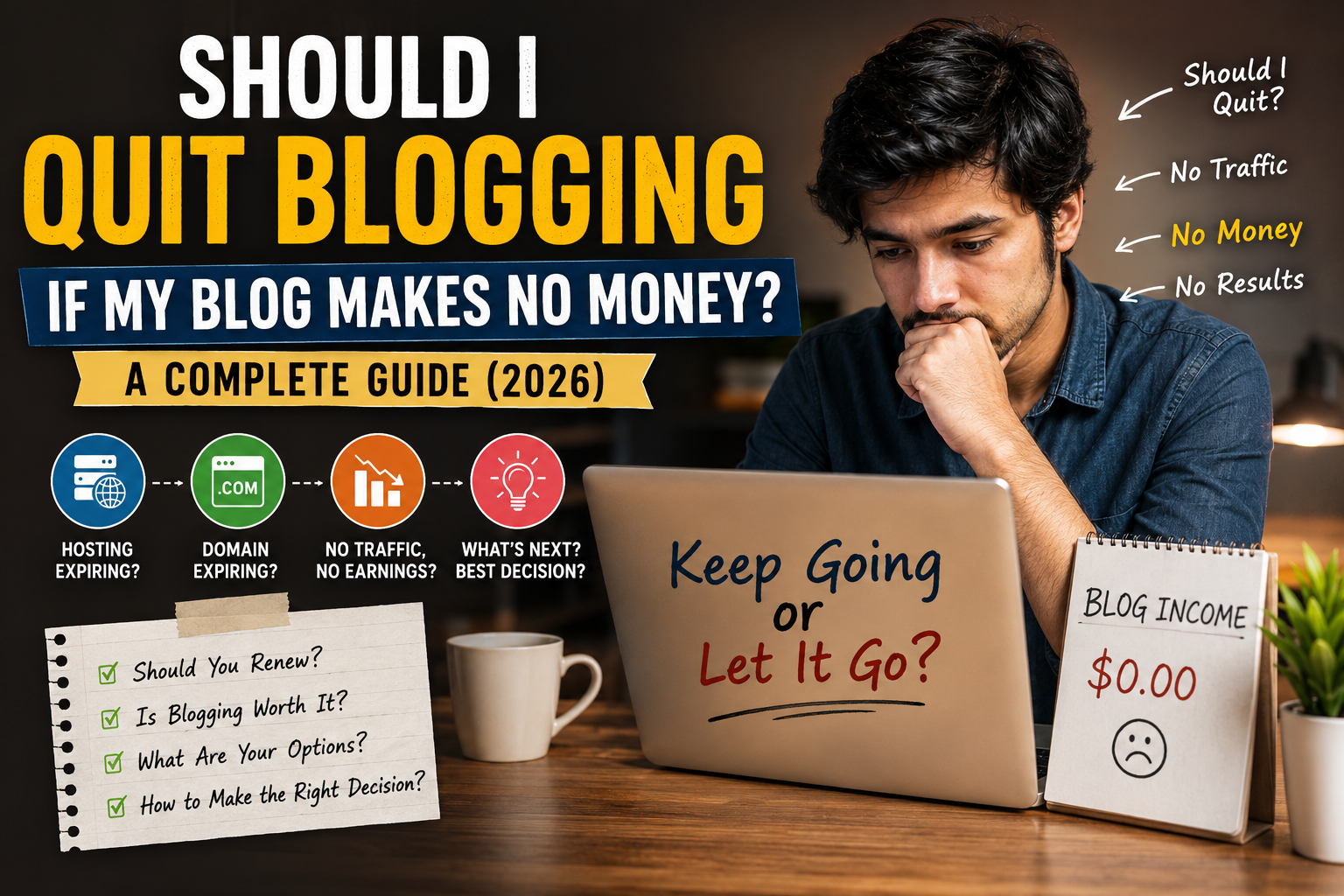
Should I Quit Blogging If My Hosting and Domain Are Expiring? Here’s What I’d Do
If you’re reading this, chances are you’re facing a difficult decision.
Your hosting plan is about to expire.
Your domain renewal is due.
You’ve spent months writing blog posts, learning SEO, and waiting for Google traffic—but the earnings are still zero.
The question starts running through your mind:
“Should I just quit blogging?”
I’ve seen this situation countless times, and the answer isn’t as simple as “yes” or “no.”
Before you cancel your hosting or renew for another year, let’s look at the bigger picture.
First, You’re Not Alone
Many new bloggers expect to earn money within a few months.
Unfortunately, blogging usually doesn’t work that way.
A brand-new website often takes 6–18 months before it starts getting consistent search traffic.
Some blogs grow quickly.
Others take much longer.
That doesn’t automatically mean you’ve failed.
Why Most New Blogs Don’t Make Money
Here are the most common reasons.
1. Not Enough High-Quality Content
Publishing 20 or 30 articles is rarely enough in competitive niches.
Many successful blogs have 100–300 helpful articles before they see significant income.
2. SEO Takes Time
Google needs time to trust a new website.
Even well-written articles may stay invisible for months before climbing in search results.
Patience is part of the process.
3. Choosing the Wrong Keywords
Many beginners target keywords that are too competitive.
Instead, focus on long-tail keywords with lower competition and clear search intent.
For example:
❌ Best Horoscope
✅ Capricorn Love Horoscope for Singles in September 2026
The second keyword is much easier to rank for.
4. No Promotion
Publishing content isn’t enough.
Share your articles through:
- Facebook Groups
- Reddit (where appropriate)
- Quora
- Email newsletters
- LinkedIn (for professional topics)
Traffic doesn’t always come from Google alone.
5. Weak Monetization Strategy
Many bloggers depend only on Google AdSense.
In reality, successful blogs often earn through:
- Affiliate marketing
- Sponsored posts
- Digital products
- Online tools
- Email marketing
- Freelance services
Diversifying your income can make a huge difference.
Before You Renew Your Hosting, Ask Yourself These Questions
Is My Website Getting Traffic?
Check:
- Google Search Console
- Google Analytics
Even 20–50 daily visitors show that Google has started noticing your content.
Are My Rankings Improving?
Look for:
- More impressions
- Better keyword positions
- Increasing clicks
- More indexed pages
Growth, even if slow, is a positive sign.
Am I Enjoying Blogging?
If you genuinely enjoy researching and writing, you’re more likely to stick with it long enough to succeed.
If blogging feels like a chore every day, it may be worth reconsidering your strategy.
Can I Afford One More Year?
Be honest with yourself.
If renewing your hosting and domain creates financial stress, it’s okay to pause.
Never go into debt for a blog.
When You Should Renew
Renew your hosting and domain if:
- Your traffic is steadily increasing.
- Your impressions are growing every month.
- Google is indexing your content.
- You’re learning SEO and improving.
- You can comfortably afford the renewal.
Think of it as investing in a long-term project.
When It Might Be Better to Stop
It may be time to stop if:
- You haven’t updated the blog for months.
- You no longer enjoy writing.
- You’ve lost interest in the topic.
- You can’t afford the renewal.
- You’d rather focus on another business or career.
Stopping doesn’t mean failure.
Sometimes, changing direction is the smartest move.
Alternatives Instead of Quitting
If you don’t want to renew immediately, consider these options.
Export Your Content
Always back up your website before your hosting expires.
Save your posts, images, and database.
You can restore them later.
Complete WordPress Backup and Restore Guide (Personally Tested on Hostinger)
Move to Cheaper Hosting
Many hosting companies offer affordable starter plans.
Migrating your site can reduce costs while keeping your content online.
Change Your Strategy
Instead of publishing every topic you can think of:
- Focus on one niche.
- Target low-competition keywords.
- Update old articles.
- Improve internal linking.
- Build backlinks naturally.
- Create genuinely helpful content.
Quality beats quantity.
Build an Email List
Even a small email list gives you an audience you own, regardless of search engine changes.
My Personal Recommendation
If your website is already showing:
- growing impressions,
- increasing clicks,
- better rankings,
- and you can afford another year,
I would renew the hosting.
SEO often rewards consistency.
Many blogs don’t earn much in their first year but improve significantly once Google gains confidence in the site.
However, if the blog has no traffic, no rankings, and you’ve lost motivation, it may be wiser to pause, learn from the experience, and start a stronger project later.
Blogging Is a Marathon, Not a Sprint
The biggest mistake new bloggers make is expecting quick money.
Successful blogs are built through consistency, patience, and continuous improvement.
Every article teaches you something.
Every ranking builds trust.
Every visitor is a sign of progress.
Whether you renew or move on, make the decision based on data—not frustration.
Frequently Asked Questions
How long does it usually take for a blog to make money?
Many blogs take 6–18 months before generating meaningful income, depending on the niche, content quality, and SEO strategy.
Should I renew my domain if I have no earnings?
If you’re seeing steady traffic or ranking improvements and can afford the renewal, keeping your domain may be worthwhile.
Can I pause my blog and continue later?
Yes. As long as you keep your content backed up and your domain active, you can restart whenever you’re ready.
Is AdSense the only way to earn from blogging?
No. Affiliate marketing, sponsored content, digital products, online tools, and freelance services are all common income sources.
What if my blog still gets no traffic?
Review your keyword strategy, update older posts, improve on-page SEO, and promote your content through multiple channels instead of relying only on Google.
Final Thoughts
Don’t let a single renewal date decide your future as a blogger.
Look at your data, your budget, and your motivation.
If your blog is improving, even slowly, another year may be the turning point.
If it’s no longer the right path for you, that’s okay too. Every project teaches valuable skills you can use in your next opportunity.
The goal isn’t just to keep a blog alive—it’s to build something that you’re proud of and that genuinely helps people.